Is Parasailing on St. Pete Beach Safe? Honest Answer and Who Shouldn't Go
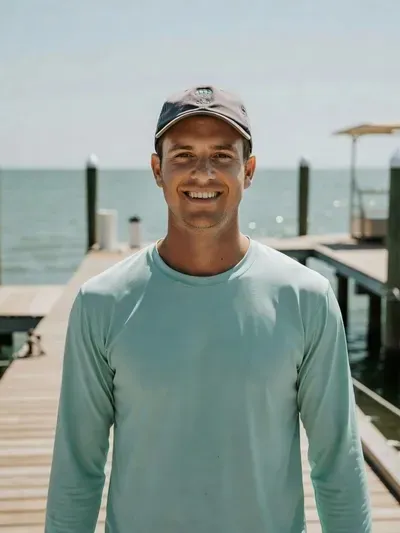
Is parasailing on St. Pete Beach safe? Statistically, yes: Americans take an estimated 3 to 5 million parasail rides a year, and the fatality rate is roughly 1 in 500,000. It genuinely isn't risk-free, and it genuinely isn't for everyone. Florida flies under the strictest parasailing law in the country, and this coast still enforces real weight, age, and medical restrictions that exclude some travelers outright. As a USCG-licensed captain who has flown hundreds of guests off Blind Pass since 2017, I'll walk through the real numbers, the regulation that makes Florida different, the actual risks and how good operators manage them, and exactly who should think twice before booking.
Quick answer
Parasailing on St. Pete Beach is statistically very safe: an estimated 3 to 5 million rides happen across the US every year, with a fatality rate near 1 in 500,000 participants. It isn't risk-free, and it genuinely isn't for everyone, pregnancy and certain weight or medical conditions rule some travelers out entirely.
Key takeaways
- Safety record: roughly 1 fatality per 500,000 US parasail rides, with equipment failure, not rider error, behind most serious incidents
- Florida is regulated under the White-Miskell Act, the strictest state parasailing law in the country, effective since October 1, 2014
- The two most common exclusions: pregnancy and a combined flyer weight outside the 130 to 450 lb (59-204 kg) range
- Vet an operator by asking to see their liability insurance proof and USCG captain's license, both are legally required to be available on request
- The full restrictions table below covers weight, age, pregnancy, and medical conditions row by row
Who Should Reconsider
If you're pregnant
this activity is excluded across Gulf Coast operators; see the alternative below for excluded riders.
If you have a heart condition or high blood pressure
talk to your doctor first and ask the operator directly about the launch and landing jolt before booking.
If you've had recent back, neck, or heart surgery
reconsider; the harness jolt at launch and landing is the specific reason operators exclude these conditions.
If you or your group's combined weight falls outside 130 to 450 lbs (59-204 kg)
call ahead, the exact number shifts daily with wind and is always the captain's call on the day.
If you or a child weighs under 40 lbs (18 kg)
the harness won't fit safely; consider an observer seat instead.
The Safety Record: What the Numbers Say
Americans take an estimated 3 to 5 million parasail rides a year, and the fatality rate works out to roughly 1 in 500,000 participants. From 2000 to 2015, parasailing accounted for 79 incidents reported to the US Coast Guard, which is 1.2% of all recreational boating accidents nationally, a small slice given how common the activity is.
The NTSB's 2014 special investigation into parasailing found that equipment failure, mostly worn or overloaded towlines, was behind nearly every serious accident, not rider error. That finding is exactly what pushed Florida to pass the strictest parasailing law in the country the same year, the White-Miskell Act. For everyday context, the rate here sits closer to the order of risk of a routine car trip than to a genuinely high-risk activity, though that comparison is offered once and not stacked further, since one honest comparison says more than three.
The full text of the NTSB's findings is public; see the NTSB's safety studies for the agency's marine safety work.
It's worth separating this from a different question readers sometimes mean when they ask if St. Pete Beach is safe: crime or general conditions in the town itself. That's a destination-level question outside what a parasailing guide can responsibly judge. For current advisories, the US State Department's official travel advisory system is the right source for international trips, and for a domestic Florida beach town, ordinary big-city common sense applies. This guide covers activity safety inside the flight itself, which is a narrower and more answerable question.
What Makes Florida Different: The White-Miskell Act
Florida's parasailing law, Florida Statute 327.37, took effect October 1, 2014, and is the strictest state parasailing law in the country. It's named the White-Miskell Act after Amber White and Kathleen Miskell, two women killed in pre-regulation Florida parasailing accidents, and it exists because Florida flies more parasail trips than any other state. The law came out of years of advocacy following those accidents, and it's the direct regulatory response the NTSB's investigation pointed toward, turning what had been operator discretion into a legal weather standard every boat has to follow the same way.
Under the Act, commercial parasailing is prohibited when:
- Sustained wind exceeds 20 mph (17 knots)
- Gusts top 25 mph (22 knots), or run 15 mph above the sustained speed
- A known lightning storm sits within 7 statute miles (11 km) of the flight area
- Rain or fog cuts visibility below half a statute mile
Beyond the weather thresholds, the law requires every commercial operator to carry liability insurance of at least $1 million per occurrence and $2 million annual aggregate, and to show proof to any customer who asks. The captain must hold a US Coast Guard license and log weather conditions before and during every flight. These aren't suggestions the operator can skip on a busy day, they're the legal minimum every licensed Florida boat has to meet, the featured St. Pete Beach trip included.
The Real Risks and How Good Operators Manage Them
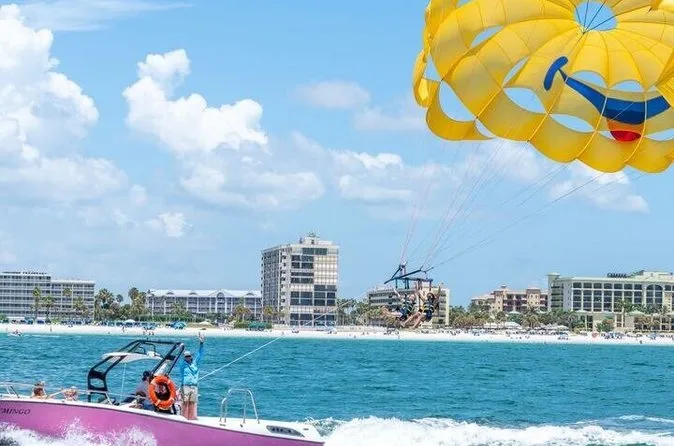
Five real risk mechanisms specific to this activity, each paired with what a competent Gulf Coast operator actually does about it:
| Situation | What a good operator does | Warning sign |
|---|---|---|
| A worn or overloaded towline, the leading cause identified by the NTSB | Inspects and replaces lines on a regular schedule, never overloads the rated weight | Visibly frayed or knotted line, or a crew that can't say when it was last replaced |
| Wind or a squall building mid-afternoon | Stands down before the 20 mph sustained threshold, watches the horizon and radar proactively | A crew pushing to fit one more flight in as clouds build to the west |
| A weight mismatch between flyers on a tandem or triple flight | Weighs riders honestly and adjusts the flyer combination to stay inside the safe combined range | No weight check at all before boarding |
| Lightning within range of the flight area | Stops flights immediately once a storm is reported within 7 miles (11 km), per the legal requirement | Flying on with visible lightning anywhere near the horizon |
| A rushed pre-flight briefing | Takes the time to explain the harness, the winch, and what to do at launch and landing before anyone boards | Handing over a waiver with no verbal briefing at all |
Every one of these mechanisms is manageable with a competent, licensed crew, which is exactly why operator choice, covered next, is the single biggest lever a rider actually controls.
How to Choose a Safe Operator on St. Pete Beach
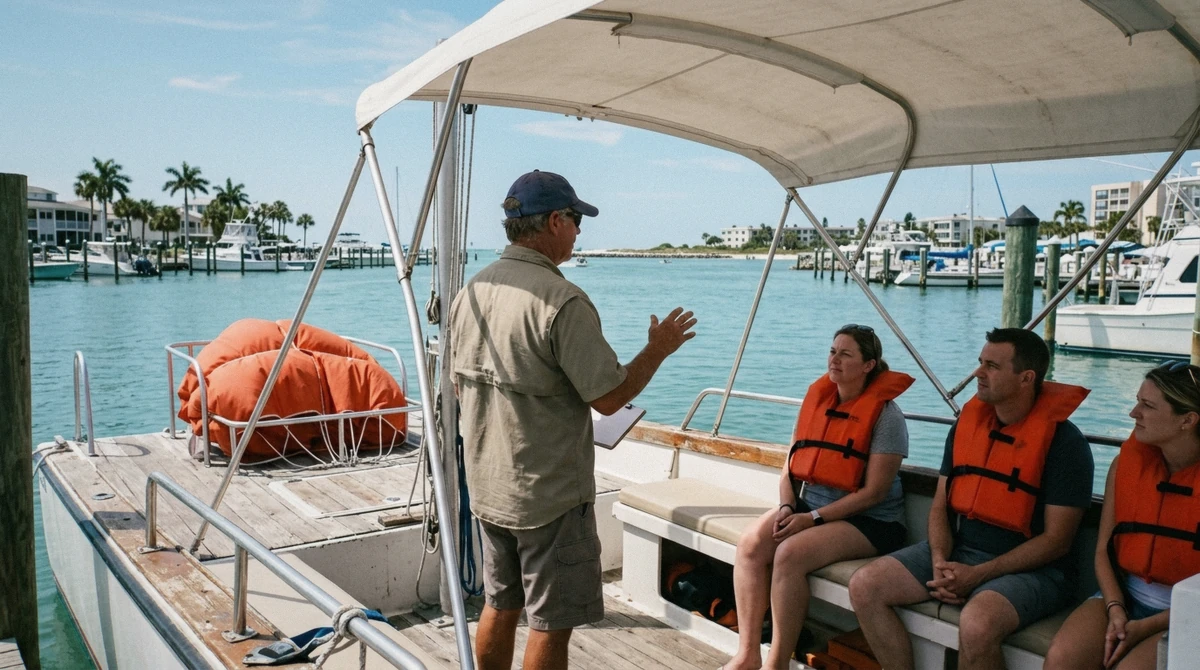
The law requires every Florida operator to carry $1 million per-occurrence liability insurance and show proof on request, so ask to see it; a legitimate operator will produce it without hesitation. Ask whether the captain holds a US Coast Guard license, this is also a legal requirement, not an extra courtesy. Ask, too, how the crew makes the go or no-go call on a marginal day, a confident, specific answer, tied to the wind and lightning thresholds in the Act, is itself a good sign. Green flags: an unhurried briefing before you board, visible harnesses and life vests in good condition, and a crew willing to cancel outright in marginal conditions rather than push ahead.
Red flags, named specifically: a rushed waiver signature with no real briefing, a crew saying something like "we'll squeeze one more in" as weather turns, gear that looks worn or mismatched, and no weight check before a tandem or triple flight boards. A confirmation message naming your actual pickup time the day before is a small but real signal too, since it shows the operator runs an organized business, not just a booking page. One more practical note, unattended valuables on an open boat are a property risk, not a physical one, so keep bags zipped and within reach at the dock and on board; it's a separate concern from the flight itself but worth a mention.
Who Shouldn't Fly: Restrictions at a Glance
Every restriction below reflects what Gulf Coast operators, this trip included, actually enforce, current as of August 2026.
| Restriction | Typical rule on St. Pete Beach trips | Why it exists | Ask before booking if... |
|---|---|---|---|
| Pregnancy | Excluded | The harness jolt at launch and landing is the reason operators exclude pregnant riders universally | You're pregnant at any stage |
| Minimum age | age 5 and up | Younger children can't safely fit or manage the harness | You're traveling with a child under 5 |
| Weight, individual (minimum) | Roughly 40 lbs (18 kg) minimum | The harness needs a minimum weight to fit and function safely | A child or small adult is close to this floor |
| Weight, combined (min-max) | Roughly 130 lbs (59 kg) minimum to 450 lbs (204 kg) maximum, combined for the flight group | The tow line and canopy are rated for a safe combined load; the exact figure shifts daily with wind and is always the captain's call | Your group's combined weight is near either end of this range |
| Heart condition or high blood pressure | Not formally barred, but a real consideration | Sustained lift and the harness jolt can add cardiovascular strain | You have a diagnosed heart condition or uncontrolled blood pressure, talk to your doctor first |
| Back, neck problems, or recent surgery | Excluded | The harness jolt at launch and landing is the same reason pregnancy is excluded | You've had recent back, neck, or spinal surgery |
| Mobility limitations | Case by case, ask the operator directly | Boarding and the harness fit require some independent movement | You use a mobility aid or have limited independent movement |
| Swimming ability | Not required | You take off and land dry via winch, and US Coast Guard-approved flotation is worn the whole flight | You're a non-swimmer and want extra reassurance before booking |
| Intoxication | Not permitted | Riders need to follow safety instructions immediately during launch and landing | You or a companion plan to drink beforehand |
What If Something Goes Wrong: Scenarios, Honestly
Wind picks up mid-flight
What happens: conditions can shift while you're already in the air on a longer flight day. What the crew does: reels you back in promptly and ends flights for the day if conditions cross the legal thresholds. What you do: trust the crew's call even if it cuts your flight short, it's the law working as intended, not the operator being overly cautious.
A line or gear issue is spotted
What happens: a crew doing a proper pre-flight check occasionally finds wear that needs addressing. What the crew does: swaps the gear before your flight rather than after, since Florida-licensed operators maintain and replace lines on a schedule, not just after something fails. What you do: nothing, this is the entire point of choosing a licensed operator, the check happens before you're ever at risk.
A water landing happens
What happens: on rare occasions a flight ends with a dip in the Gulf rather than back on the deck, sometimes intentionally requested, sometimes not. What the crew does: you're wearing US Coast Guard-approved flotation the entire flight, and the boat comes back around to winch you in. What you do: stay calm, the flotation does the work, and this is a routine recovery for a trained crew.
Across every scenario above, the one safety lever fully within your control is operator choice: a licensed, insured Florida operator that logs weather and stands down at the legal thresholds is doing the job the White-Miskell Act was written to require. That single decision matters more than anything that happens once you're already airborne. It's worth saying plainly that none of these scenarios are common; they're included here precisely because good operators plan for them, not because they happen often on a well-run boat.
If You're Excluded: What to Do Instead
If pregnancy, a recent surgery, or a weight limit rules you out, you don't have to skip the trip entirely. An observer seat on the same boat gets you the full channel ride and the same dolphin sightings the flyers see, just without the harness. It's the genuine alternative for excluded riders, and it costs a fraction of the flight price, roughly $20 to $40 depending on the operator; our cost breakdown covers observer fares alongside the flight prices.
It's also a practical option for anyone in the group who is simply undecided, since most operators let an observer switch to flying mid-trip if a seat opens up and conditions allow.
Standard commercial flights on this coast run 200 to 400 feet (60 to 120 meters) above the Gulf, well under the FAA's 500 feet ceiling; our worth it guide covers the altitude and value math in full. For emergencies on the day, call 911 from any phone; Blind Pass Road sits about 25 to 30 minutes from downtown St. Petersburg's hospitals and closer still to Treasure Island's nearest urgent care. The operator's dock office keeps basic first-aid on board every boat, and the captain is trained to head back to the dock immediately if a medical situation calls for it.
This is the same standard every licensed Gulf Coast operator is expected to meet, not something unique to one boat.
Frequently Asked Questions
Has anyone died parasailing in Florida?
Yes, in pre-regulation accidents that led directly to the White-Miskell Act in 2014. Since then, Florida operators fly under the strictest state parasailing law in the country, and the national fatality rate across all US parasail rides sits at roughly 1 in 500,000.
Can I fly pregnant?
No. Pregnancy is excluded across Gulf Coast operators because of the harness jolt at launch and landing. An observer seat on the same boat is the alternative.
What's the weight limit for parasailing?
Roughly 40 lbs (18 kg) minimum per flyer for the harness to fit, and a combined group weight of about 130 to 450 lbs (59-204 kg), which shifts daily with wind and is always the captain's call.
Do I need to know how to swim?
No. Takeoff and landing happen on the boat deck via winch, and you wear US Coast Guard-approved flotation for the entire flight.
Is parasailing safe with a heart condition or bad back?
A bad back or recent back, neck, or heart surgery generally excludes a rider, since the harness jolt at launch and landing is the concern. A heart condition or high blood pressure isn't formally barred but is worth a doctor's input first, given the sustained lift and exertion.
Does travel insurance need to cover parasailing specifically?
Often not by default. Parasailing appears on some standard policies' adventure-sport exclusion lists, so confirm your policy covers it or ask about an add-on rider before you fly; this is about health and injury coverage, separate from trip-cost refunds, which our weather-cancellations guide covers.
Will disclosing a medical condition automatically disqualify me?
Not always. Pregnancy and recent back, neck, or heart surgery are hard exclusions across Gulf Coast operators. Conditions like a managed heart condition or high blood pressure are usually a conversation with the crew, and with your own doctor beforehand, rather than an automatic no. Disclose honestly at booking; it's the one detail a crew can't see for themselves.
None of this is theoretical for me. Weather calls, weight checks, and the occasional excluded rider are part of a normal week on the water here, not abstract policy. Parasailing on St. Pete Beach is safe by the numbers that actually exist: roughly 1 fatality per 500,000 US rides, and a Florida law written specifically to close the gaps that caused past accidents.
It genuinely isn't risk-free, and it genuinely isn't for everyone, pregnancy, certain weight ranges, and a handful of medical conditions rule some travelers out honestly. The one lever most within your control is the operator you choose: ask about insurance and licensing before you pay, and book the St. Pete Beach parasail trip with an operator that meets every White-Miskell Act requirement.